
The Story of Japanese Denim – From Tradition to Craftsmanship
🇯🇵 The Story of Japanese Denim – From Tradition to Craftsmanship
Japanese denim is more than just fabric — it’s a reflection of craftsmanship, patience, and cultural heritage. Let’s take a quiet walk through its history and what makes it so special.
1️⃣ Denim Arrives in Japan
After World War II, jeans entered Japan through U.S. military surplus and movies from abroad. They quickly became symbols of freedom and modern style among young people. By the 1960s, domestic denim production began — a turning point that would later influence global denim culture.
2️⃣ The Birth of Denim Regions
The heart of Japanese denim beats in western Japan — especially along the calm coastlines of the Seto Inland Sea. Towns such as Okayama, Fukuyama, and Hiroshima had long traditions of weaving and natural dyeing. When denim arrived, these skills evolved naturally into a unique form of craftsmanship. Local mills refined techniques of spinning, dyeing, and weaving, creating fabrics known for their depth of color and durability.
3️⃣ What Makes Japanese Denim Distinctive
- Indigo Rope Dyeing – A time-intensive process that creates deep, uneven shades of blue that fade beautifully with wear.
- Vintage Shuttle Looms – Traditional machines weave tightly finished selvedge denim, giving each fabric its own texture and character.
- Meticulous Finishing – Every process, from washing to stitching, is done with patience and precision.
- Monozukuri Spirit – The Japanese philosophy of craftsmanship that values sincerity, care, and quiet perfection through repetition.
Rather than claiming to be “the best,” Japanese denim is respected worldwide for its harmony between tradition and innovation — where every detail tells a story of dedication.
4️⃣ Indigo & Japanese Dyeing Culture
Long before denim arrived, Japan had cherished indigo dyeing for centuries. Known as “Japan Blue”, its deep hue was believed to bring purity, calm, and protection. The philosophy behind indigo — patience, repetition, and respect for natural materials — quietly lives on in the country’s modern denim craftsmanship.
5️⃣ Fun Facts
- The first selvedge denim produced in Japan appeared in the early 1970s, marking the beginning of domestic denim culture.
- Many schools in western Japan still use locally woven denim for uniforms, showing how deeply the craft is rooted in everyday life.
- The term “Japan Blue” was once used by Western travelers to describe the beautiful indigo color seen throughout Japanese textiles.
6️⃣ Closing – Wearing a Piece of Tradition
Japanese denim is not just a material — it’s a story woven with care. Behind each thread lies a blend of heritage, craftsmanship, and quiet pride. To wear Japanese denim is to carry a small piece of this enduring tradition — a harmony of nature, patience, and human touch.
“Every stitch tells a story — calm, honest, and made with heart.”

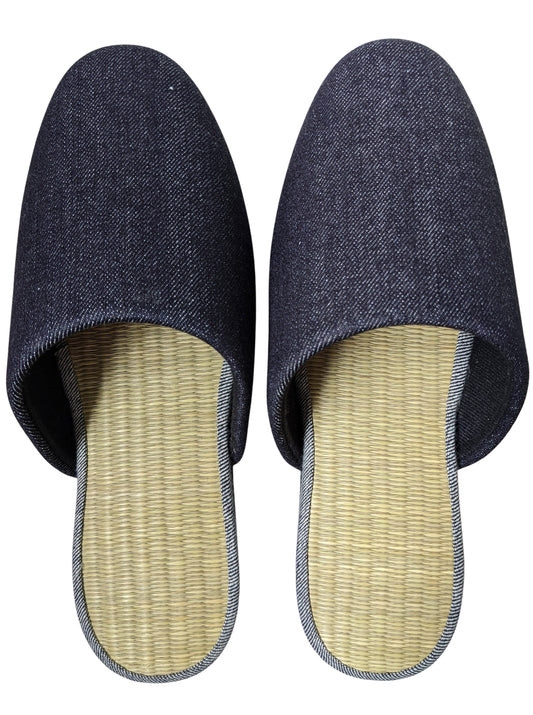


![TATAMI Denim Slippers B-Type [Black Wool Felt Sole] / Simple [Denim Hiroshima] - Heiwa Slipper](http://heiwaslipper.com/cdn/shop/products/PXL_20220625_014342749.jpg?v=1656474603&width=533)
![TATAMI Denim Slippers B-Type [Black Wool Felt Sole] / Simple [Denim Hiroshima]](http://heiwaslipper.com/cdn/shop/products/01c5f57e8fd14c23a43ae25accc9782c.thumbnail.0000000.jpg?v=1656474595&width=533)


![Wood summer Indoor slippers YORU [Indoor] - Heiwa Slipper](http://heiwaslipper.com/cdn/shop/products/PXL_20220305_023859778_b6eb97cf-5b3f-4cb3-8b27-dc6175a726a3.jpg?v=1676772560&width=533)
![Wood summer Indoor slippers YORU [Indoor] - Heiwa Slipper](http://heiwaslipper.com/cdn/shop/products/221dbc310353bfdfe8747210eafe6a96_9611d4d2-ef9b-4b06-b357-9f4f825470c8.jpg?v=1676772560&width=533)
![Wood Unpainted Natural GETA ZOURI Slippers [Outdoor] - Heiwa Slipper](http://heiwaslipper.com/cdn/shop/products/PXL_20230205_021218589.jpg?v=1675997531&width=533)
![Wood Unpainted Natural GETA ZOURI Slippers [Outdoor]](http://heiwaslipper.com/cdn/shop/products/4bd6786738cd4777af9a25d3005e7fec.thumbnail.0000000000.jpg?v=1675736665&width=533)
![Black Wood painted GETA Slippers [Outdoor / Indoor] - Heiwa Slipper](http://heiwaslipper.com/cdn/shop/products/PXL_20230205_014733671.jpg?v=1676343138&width=533)
![Black Wood painted GETA Slippers [Outdoor / Indoor]](http://heiwaslipper.com/cdn/shop/products/6743267dad824b0787df8618829f743d.thumbnail.0000000000.jpg?v=1676341291&width=533)
![Uwabaki Type #01 [Cobalt blue] Japan made school indoor shoes - Heiwa Slipper](http://heiwaslipper.com/cdn/shop/files/1_774e840e-b3c1-4a23-b85f-df7b8ceacf02.jpg?v=1734232769&width=533)
![Uwabaki Type #01 [Cobalt blue] Japan made school indoor shoes - Heiwa Slipper](http://heiwaslipper.com/cdn/shop/files/2_e1a26258-95fd-461d-a07c-a2028b8334c0.jpg?v=1734232769&width=533)
![Uwabaki Type #01 [Blue] Japan made school indoor shoes - Heiwa Slipper](http://heiwaslipper.com/cdn/shop/files/1_b6310388-146d-4db8-8fc6-9efea05e5cdd.jpg?v=1730601209&width=533)
![Uwabaki Type #01 [Blue] Japan made school indoor shoes](http://heiwaslipper.com/cdn/shop/files/preview_images/00ddc0ebe039486ba930ba1484c6abff.thumbnail.0000000000.jpg?v=1730601987&width=533)

![Uwabaki Type #01 [White] Japan made school indoor shoes](http://heiwaslipper.com/cdn/shop/files/preview_images/8b07db1bea8544409ca9b26f3995178f.thumbnail.0000000000.jpg?v=1716774889&width=533)
![Uwabaki Type #01 [Red] Japan made school indoor shoes - Heiwa Slipper](http://heiwaslipper.com/cdn/shop/files/1_b6a613f3-7a33-4747-b00f-9af7dd1dce5f.jpg?v=1734234054&width=533)
![Uwabaki Type #01 [Red] Japan made school indoor shoes - Heiwa Slipper](http://heiwaslipper.com/cdn/shop/files/2_d39644c6-6955-4644-98c4-0b1fde3d6db2.jpg?v=1734234054&width=533)
![Black Gold Triangle Shiny Slippers [Large / XL] - Heiwa Slipper](http://heiwaslipper.com/cdn/shop/products/PXL_20220911_020329137.jpg?v=1668920339&width=533)
![Black Gold Triangle Shiny Slippers [Large / XL] - Heiwa Slipper](http://heiwaslipper.com/cdn/shop/products/PXL_20220911_020348548.jpg?v=1668920313&width=533)
![Medium | Knit up-cycle slippers 2024-M120 [Medium]](http://heiwaslipper.com/cdn/shop/files/1_74e6bb20-9457-4005-b920-1da4aa2fc0d3.jpg?v=1731672250&width=533)
![Medium | Knit up-cycle slippers 2024-M120 [Medium]](http://heiwaslipper.com/cdn/shop/files/4_787e681d-8081-496a-bc25-b24dab67d34f.jpg?v=1731672250&width=533)
![Medium | Knit up-cycle slippers 2024-M119 [Medium]](http://heiwaslipper.com/cdn/shop/files/1_f559f61a-b720-4b6c-9379-974266bdddeb.jpg?v=1731671453&width=533)
![Medium | Knit up-cycle slippers 2024-M119 [Medium]](http://heiwaslipper.com/cdn/shop/files/5_c7010731-884e-4374-a501-69bce7f7164a.jpg?v=1731671453&width=533)
![Medium | Knit up-cycle slippers 2024-M118 [Medium]](http://heiwaslipper.com/cdn/shop/files/1_4f7f701e-bcb4-469a-b9bc-7cfbec1bf50f.jpg?v=1731670790&width=533)
![Medium | Knit up-cycle slippers 2024-M118 [Medium]](http://heiwaslipper.com/cdn/shop/files/4_5526ef4a-899c-4a92-843e-bd5022a7b922.jpg?v=1731670789&width=533)
![Medium | Knit up-cycle slippers 2024-M117 [Medium]](http://heiwaslipper.com/cdn/shop/files/1_da150a42-c6f5-4fc7-95cc-696990456578.jpg?v=1731669514&width=533)
![Medium | Knit up-cycle slippers 2024-M117 [Medium]](http://heiwaslipper.com/cdn/shop/files/4_c8f22448-bb97-4d00-909b-713256757b57.jpg?v=1731669513&width=533)
![Medium | Knit up-cycle slippers 2024-M116 [Medium] - Heiwa Slipper](http://heiwaslipper.com/cdn/shop/files/1_77365f74-aab6-4356-9b7f-90ba42d47f4e.jpg?v=1731668957&width=533)
![Medium | Knit up-cycle slippers 2024-M116 [Medium] - Heiwa Slipper](http://heiwaslipper.com/cdn/shop/files/5_d910f8da-39c2-4f8f-83f2-f67a4efd89ad.jpg?v=1731668957&width=533)
![Medium | Knit up-cycle slippers 2024-M115 [Medium]](http://heiwaslipper.com/cdn/shop/files/1_22b912db-7a3b-4e60-9efa-290d27cbf2de.jpg?v=1731642622&width=533)
![Medium | Knit up-cycle slippers 2024-M115 [Medium]](http://heiwaslipper.com/cdn/shop/files/2_59ac7cff-bc23-425e-8ad6-2753017e34b9.jpg?v=1731642622&width=533)
![Medium | Knit up-cycle slippers 2024-M114 [Medium]](http://heiwaslipper.com/cdn/shop/files/1_23cd6836-0c59-41e8-b11e-5f1b9a9e1db4.jpg?v=1731641964&width=533)
![Medium | Knit up-cycle slippers 2024-M114 [Medium]](http://heiwaslipper.com/cdn/shop/files/5_63997f3b-9e8b-406d-a486-361737300d21.jpg?v=1731641963&width=533)
![Medium | Knit up-cycle slippers 2024-M113 [Medium]](http://heiwaslipper.com/cdn/shop/files/1_a377de3c-c6f5-4868-bf59-1ad164dd6c67.jpg?v=1731641270&width=533)
![Medium | Knit up-cycle slippers 2024-M113 [Medium]](http://heiwaslipper.com/cdn/shop/files/4_b70af802-9ca5-43bb-8036-d5e8141d55c1.jpg?v=1731641270&width=533)
![Medium | Knit up-cycle slippers 2024-M112 [Medium]](http://heiwaslipper.com/cdn/shop/files/1_2b43d953-aa8c-49ca-9f11-f88334b75ed5.jpg?v=1731639427&width=533)
![Medium | Knit up-cycle slippers 2024-M112 [Medium]](http://heiwaslipper.com/cdn/shop/files/4_c6a2d9e1-8c7a-4060-9950-17817b75ac96.jpg?v=1731639427&width=533)
![Medium | Knit up-cycle slippers 2024-M111 [Medium]](http://heiwaslipper.com/cdn/shop/files/1_99a9047c-a2fd-4843-84d3-2225abfca327.jpg?v=1731638613&width=533)
![Medium | Knit up-cycle slippers 2024-M111 [Medium]](http://heiwaslipper.com/cdn/shop/files/2_47aebdf4-72c8-417e-b084-11ecb43fb627.jpg?v=1731638613&width=533)
![Medium | Knit up-cycle slippers 2024-M110 [Medium]](http://heiwaslipper.com/cdn/shop/files/1_5ce71ce4-d1e1-4e4b-926e-965373d6f956.jpg?v=1731587890&width=533)
![Medium | Knit up-cycle slippers 2024-M110 [Medium]](http://heiwaslipper.com/cdn/shop/files/4_83216e03-5cbf-4018-be81-db22572f752a.jpg?v=1731587890&width=533)
![Medium | Knit up-cycle slippers 2024-M109 [Medium]](http://heiwaslipper.com/cdn/shop/files/1_39fbaa6d-d89d-4252-ba57-4ab08c97e18b.jpg?v=1731587213&width=533)
![Medium | Knit up-cycle slippers 2024-M109 [Medium]](http://heiwaslipper.com/cdn/shop/files/4_69c82117-f469-413e-a9e1-b65ee9be909a.jpg?v=1731587212&width=533)
![Uwabaki Type #01 [Yellow] Japan made school indoor shoes - Heiwa Slipper](http://heiwaslipper.com/cdn/shop/files/PXL_20231203_013919940_2cb6643e-3792-4570-a478-48e9292dd66e.jpg?v=1716433566&width=533)
![Uwabaki Type #01 [Yellow] Japan made school indoor shoes - Heiwa Slipper](http://heiwaslipper.com/cdn/shop/files/PXL_20231203_013924997_6ec89008-e83d-49be-a754-189a4394f3d7.jpg?v=1716433310&width=533)
![Uwabaki Type #01 [Green] Japan made school indoor shoes](http://heiwaslipper.com/cdn/shop/files/1_0e97bd6f-50fa-4892-865f-d3a8de9c6c47.jpg?v=1730601600&width=533)
![Uwabaki Type #01 [Green] Japan made school indoor shoes](http://heiwaslipper.com/cdn/shop/files/preview_images/a0e1cab212ce428ea71baffd633ef028.thumbnail.0000000000.jpg?v=1730602087&width=533)