
The Science of Tatami Scent: What Research Says About Igusa
The Science of Tatami: What's Actually Been Measured About Igusa's Scent
If you've ever stepped into a tatami room and felt your shoulders drop a little, scent may be part of the experience. The grassy, faintly sweet smell of tatami comes from igusa, or Japanese rush, and a small but real body of research has examined how its volatile compounds affect the nervous system. It fits naturally into today's broader interest in natural materials, slow living, and Japanese-inspired interiors — and it's the material behind our tatami line, the flagship collection at Heiwa Slipper (alongside our denim and upcycled lines, which are their own story).

What Is Igusa?
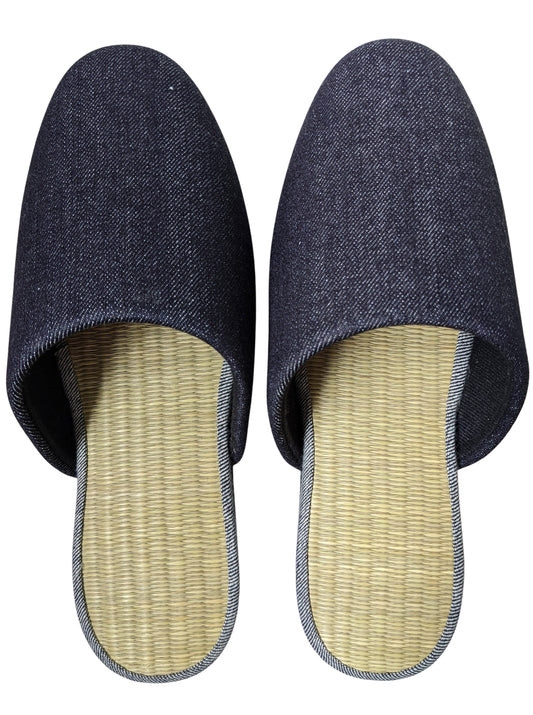
Igusa is a wetland rush plant that's been woven into Japanese flooring for over a thousand years. It's dried and pressed into tatami mats, and the same dried material is woven into other objects — mats, sandals, and the soles of our tatami-line slippers. As it dries, it releases a set of aromatic compounds that give tatami its characteristic smell.
What the Research Actually Shows
A lot of what circulates online about tatami and igusa rounds up small findings into bigger claims than the data supports. Here's what's actually been published.
The scent's chemistry is documented. A 2010 study in Bioscience, Biotechnology, and Biochemistry used gas chromatography and aroma extract dilution analysis on mat rush and revealed 51 odor-active peaks, of which 12 were judged to be the most important contributors to igusa's characteristic aroma. Eleven of those key odorants were identified or tentatively identified, including vanillin, the same compound found in vanilla.
A 2022 study involving researchers at Kyushu University found a genuinely interesting, counterintuitive result. Twenty healthy university-student participants were exposed to air scented with 15g or 30g of dried igusa (against a control), while researchers measured EEG activity, autonomic nervous activity, blood pressure, and subjective responses. Participants described the scent as sour, pungent, and not pleasant, and blood pressure and pulse rate didn't differ significantly. But even though participants did not rate the scent positively, their alpha wave amplitude and parasympathetic nervous activity — both markers associated with a relaxed state — increased, and the effect was stronger at the lower concentration. In other words, the physiological response didn't match people's subjective opinion of the smell — a more interesting, and more credible, finding than "everyone finds it pleasant and calming."

Research summarized by Kumamoto's igusa producers' cooperative reports that domestic igusa mats were associated with greater alpha-wave activity and higher measured sleep efficiency than synthetic flooring. The cooperative states this research involved Kyushu University and received support from Japan's NARO Bio-oriented Technology Research Advancement Institution, though the page itself doesn't provide a full peer-reviewed citation.
Worth sizing correctly: these are small studies, and "increased alpha wave amplitude" is a physiological marker of relaxation, not a clinical outcome. We'd rather undersell this than overclaim it.
Beyond Scent: Other Measured Properties of Igusa
Separate from the scent research, igusa's sponge-like internal structure has more straightforward, physically testable properties. Industry testing has reported adsorption of substances including formaldehyde and nitrogen dioxide, and the same structure absorbs excess humidity and releases it as air dries. Laboratory and industry materials also report growth-inhibiting activity against several common microorganisms. It's worth noting this testing comes from an industry cooperative's own materials rather than an independent peer-reviewed journal, so we'd treat it as good-faith industry data rather than academic-grade evidence.
Where Our Tatami Line Fits In
Most people outside Japan don't have a tatami room, and installing one isn't realistic for a rented apartment. Our tatami line was built around that gap: genuine dried igusa woven into the sole, not a printed pattern or synthetic substitute. Because it sits directly under your feet, you can experience the texture, breathability, and natural scent of genuine woven igusa in an everyday form. Igusa as a material has demonstrated moisture-regulating and antimicrobial characteristics in laboratory and industry testing, though those studies weren't conducted specifically on our slippers — we'd rather be upfront about that than imply otherwise.
The 2022 study described above found measurable physiological responses to VOCs from dried igusa even when participants didn't rate the scent positively. That doesn't establish a specific effect from wearing igusa slippers day to day, but it adds a genuinely interesting scientific dimension to a familiar natural material — and it's also why tatami-line slippers smell faintly grassy straight out of the box. That's the plant, not an additive.
Caring for Igusa
Think of it as a natural woven material rather than technical footwear: keep it dry, let it air out naturally between wears, and avoid prolonged direct sunlight, which helps preserve color. The scent is strongest in the first few months and mellows as the aromatic compounds gradually release — that's expected, not a sign of wear. A little care this way helps the slippers stay in good condition longer.
Frequently Asked Questions
Does the igusa scent fade over time? Yes, gradually, as the volatile compounds slowly release. This is normal and doesn't indicate the material is deteriorating.
What can the research reasonably tell us? That igusa's aroma compounds are chemically documented, and that in at least one small, controlled study, exposure to them produced measurable relaxation-associated changes in brain activity and the nervous system — even among people who didn't like the smell. It doesn't tell us that igusa cures anything, or that wearing igusa slippers reproduces the same effect as a lab-controlled scent exposure. We think that distinction matters more than a bigger claim would.
The Takeaway
The research on igusa's scent is real, peer-reviewed, and more interesting than marketing shorthand suggests — including the detail that people don't have to like the smell for it to show up in their brain waves. Combined with igusa's separately documented material properties, it's a material with a genuine, modest evidence base, applied here in a form you can actually wear.
[Explore Heiwa Slipper's tatami line →]

Sources referenced for this article:
- Kumazawa, K. et al., "Identification and Formation of Volatile Components Responsible for the Characteristic Aroma of Mat Rush (Igusa)", Bioscience, Biotechnology, and Biochemistry, 2010.
- Sun, M. et al., "Physiological and Psychological Effects of Volatile Organic Compounds from Dried Common Rush (Juncus effusus L. var. decipiens) on Humans", International Journal of Environmental Research and Public Health, 2022.
- Kumamoto Prefecture Igusa Products Wholesale Cooperative, — summarizing Kyushu University comparative research (supported by NARO's Bio-oriented Technology Research Advancement Institution) and industry formaldehyde-adsorption testing.


![TATAMI Denim Slippers B-Type [Black Wool Felt Sole] / Simple [Denim Hiroshima] - Heiwa Slipper](http://heiwaslipper.com/cdn/shop/products/PXL_20220625_014342749.jpg?v=1656474603&width=533)
![TATAMI Denim-Slipper B-Typ [Schwarze Wollfilzsohle] / Simple [Denim Hiroshima]](http://heiwaslipper.com/cdn/shop/products/01c5f57e8fd14c23a43ae25accc9782c.thumbnail.0000000.jpg?v=1656474595&width=533)


![Wood summer Indoor slippers YORU [Indoor] - Heiwa Slipper](http://heiwaslipper.com/cdn/shop/products/PXL_20220305_023859778_b6eb97cf-5b3f-4cb3-8b27-dc6175a726a3.jpg?v=1676772560&width=533)
![Wood summer Indoor slippers YORU [Indoor] - Heiwa Slipper](http://heiwaslipper.com/cdn/shop/products/221dbc310353bfdfe8747210eafe6a96_9611d4d2-ef9b-4b06-b357-9f4f825470c8.jpg?v=1676772560&width=533)
![Wood Unpainted Natural GETA ZOURI Slippers [Outdoor] - Heiwa Slipper](http://heiwaslipper.com/cdn/shop/products/PXL_20230205_021218589.jpg?v=1675997531&width=533)
![Holz Unlackiert Natur GETA ZOURI Hausschuhe [Outdoor]](http://heiwaslipper.com/cdn/shop/products/4bd6786738cd4777af9a25d3005e7fec.thumbnail.0000000000.jpg?v=1675736665&width=533)
![Black Wood painted GETA Slippers [Outdoor / Indoor] - Heiwa Slipper](http://heiwaslipper.com/cdn/shop/products/PXL_20230205_014733671.jpg?v=1676343138&width=533)
![Schwarz holzbemalte GETA-Hausschuhe [Outdoor / Indoor]](http://heiwaslipper.com/cdn/shop/products/6743267dad824b0787df8618829f743d.thumbnail.0000000000.jpg?v=1676341291&width=533)
![Uwabaki Type #01 [Cobalt blue] Japan made school indoor shoes - Heiwa Slipper](http://heiwaslipper.com/cdn/shop/files/1_774e840e-b3c1-4a23-b85f-df7b8ceacf02.jpg?v=1734232769&width=533)
![Uwabaki Type #01 [Cobalt blue] Japan made school indoor shoes - Heiwa Slipper](http://heiwaslipper.com/cdn/shop/files/2_e1a26258-95fd-461d-a07c-a2028b8334c0.jpg?v=1734232769&width=533)
![Uwabaki Type #01 [Blue] Japan made school indoor shoes - Heiwa Slipper](http://heiwaslipper.com/cdn/shop/files/1_b6310388-146d-4db8-8fc6-9efea05e5cdd.jpg?v=1730601209&width=533)
![Uwabaki Typ #01 [Blau] In Japan hergestellte Schulhallenschuhe](http://heiwaslipper.com/cdn/shop/files/preview_images/00ddc0ebe039486ba930ba1484c6abff.thumbnail.0000000000.jpg?v=1730601987&width=533)

![Uwabaki Typ #01 [Weiß] In Japan hergestellte Schulhallenschuhe](http://heiwaslipper.com/cdn/shop/files/preview_images/8b07db1bea8544409ca9b26f3995178f.thumbnail.0000000000.jpg?v=1716774889&width=533)
![Uwabaki Type #01 [Red] Japan made school indoor shoes - Heiwa Slipper](http://heiwaslipper.com/cdn/shop/files/1_b6a613f3-7a33-4747-b00f-9af7dd1dce5f.jpg?v=1734234054&width=533)
![Uwabaki Type #01 [Red] Japan made school indoor shoes - Heiwa Slipper](http://heiwaslipper.com/cdn/shop/files/2_d39644c6-6955-4644-98c4-0b1fde3d6db2.jpg?v=1734234054&width=533)
![* Pre-order *TATAMI Denim Slippers B-Type [Black Wool Felt Sole] / Simple [Denim Hiroshima] - Heiwa Slipper](http://heiwaslipper.com/cdn/shop/products/pre.jpg?v=1672973100&width=533)
![* Pre-order *TATAMI Denim Slippers B-Type [Black Wool Felt Sole] / Simple [Denim Hiroshima] - Heiwa Slipper](http://heiwaslipper.com/cdn/shop/products/PXL_20220625_014342749.webp?v=1672973100&width=533)
![Mittel | Gestrickte Upcycling-Hausschuhe 2024-M120 [Mittel]](http://heiwaslipper.com/cdn/shop/files/1_74e6bb20-9457-4005-b920-1da4aa2fc0d3.jpg?v=1731672250&width=533)
![Mittel | Gestrickte Upcycling-Hausschuhe 2024-M120 [Mittel]](http://heiwaslipper.com/cdn/shop/files/4_787e681d-8081-496a-bc25-b24dab67d34f.jpg?v=1731672250&width=533)
![Mittel | Gestrickte Upcycling-Hausschuhe 2024-M119 [Mittel]](http://heiwaslipper.com/cdn/shop/files/1_f559f61a-b720-4b6c-9379-974266bdddeb.jpg?v=1731671453&width=533)
![Mittel | Gestrickte Upcycling-Hausschuhe 2024-M119 [Mittel]](http://heiwaslipper.com/cdn/shop/files/5_c7010731-884e-4374-a501-69bce7f7164a.jpg?v=1731671453&width=533)
![Mittel | Gestrickte Upcycling-Hausschuhe 2024-M118 [Mittel]](http://heiwaslipper.com/cdn/shop/files/1_4f7f701e-bcb4-469a-b9bc-7cfbec1bf50f.jpg?v=1731670790&width=533)
![Mittel | Gestrickte Upcycling-Hausschuhe 2024-M118 [Mittel]](http://heiwaslipper.com/cdn/shop/files/4_5526ef4a-899c-4a92-843e-bd5022a7b922.jpg?v=1731670789&width=533)
![Mittel | Gestrickte Upcycling-Hausschuhe 2024-M117 [Mittel]](http://heiwaslipper.com/cdn/shop/files/1_da150a42-c6f5-4fc7-95cc-696990456578.jpg?v=1731669514&width=533)
![Mittel | Gestrickte Upcycling-Hausschuhe 2024-M117 [Mittel]](http://heiwaslipper.com/cdn/shop/files/4_c8f22448-bb97-4d00-909b-713256757b57.jpg?v=1731669513&width=533)
![Medium | Knit up-cycle slippers 2024-M116 [Medium] - Heiwa Slipper](http://heiwaslipper.com/cdn/shop/files/1_77365f74-aab6-4356-9b7f-90ba42d47f4e.jpg?v=1731668957&width=533)
![Medium | Knit up-cycle slippers 2024-M116 [Medium] - Heiwa Slipper](http://heiwaslipper.com/cdn/shop/files/5_d910f8da-39c2-4f8f-83f2-f67a4efd89ad.jpg?v=1731668957&width=533)
![Mittel | Gestrickte Upcycling-Hausschuhe 2024-M115 [Mittel]](http://heiwaslipper.com/cdn/shop/files/1_22b912db-7a3b-4e60-9efa-290d27cbf2de.jpg?v=1731642622&width=533)
![Mittel | Gestrickte Upcycling-Hausschuhe 2024-M115 [Mittel]](http://heiwaslipper.com/cdn/shop/files/2_59ac7cff-bc23-425e-8ad6-2753017e34b9.jpg?v=1731642622&width=533)
![Mittel | Gestrickte Upcycling-Hausschuhe 2024-M114 [Mittel]](http://heiwaslipper.com/cdn/shop/files/1_23cd6836-0c59-41e8-b11e-5f1b9a9e1db4.jpg?v=1731641964&width=533)
![Mittel | Gestrickte Upcycling-Hausschuhe 2024-M114 [Mittel]](http://heiwaslipper.com/cdn/shop/files/5_63997f3b-9e8b-406d-a486-361737300d21.jpg?v=1731641963&width=533)
![Mittel | Gestrickte Upcycling-Hausschuhe 2024-M113 [Mittel]](http://heiwaslipper.com/cdn/shop/files/1_a377de3c-c6f5-4868-bf59-1ad164dd6c67.jpg?v=1731641270&width=533)
![Mittel | Gestrickte Upcycling-Hausschuhe 2024-M113 [Mittel]](http://heiwaslipper.com/cdn/shop/files/4_b70af802-9ca5-43bb-8036-d5e8141d55c1.jpg?v=1731641270&width=533)
![Mittel | Gestrickte Upcycling-Hausschuhe 2024-M112 [Mittel]](http://heiwaslipper.com/cdn/shop/files/1_2b43d953-aa8c-49ca-9f11-f88334b75ed5.jpg?v=1731639427&width=533)
![Mittel | Gestrickte Upcycling-Hausschuhe 2024-M112 [Mittel]](http://heiwaslipper.com/cdn/shop/files/4_c6a2d9e1-8c7a-4060-9950-17817b75ac96.jpg?v=1731639427&width=533)
![Mittel | Gestrickte Upcycling-Hausschuhe 2024-M111 [Mittel]](http://heiwaslipper.com/cdn/shop/files/1_99a9047c-a2fd-4843-84d3-2225abfca327.jpg?v=1731638613&width=533)
![Mittel | Gestrickte Upcycling-Hausschuhe 2024-M111 [Mittel]](http://heiwaslipper.com/cdn/shop/files/2_47aebdf4-72c8-417e-b084-11ecb43fb627.jpg?v=1731638613&width=533)
![Mittel | Gestrickte Upcycling-Hausschuhe 2024-M110 [Mittel]](http://heiwaslipper.com/cdn/shop/files/1_5ce71ce4-d1e1-4e4b-926e-965373d6f956.jpg?v=1731587890&width=533)
![Mittel | Gestrickte Upcycling-Hausschuhe 2024-M110 [Mittel]](http://heiwaslipper.com/cdn/shop/files/4_83216e03-5cbf-4018-be81-db22572f752a.jpg?v=1731587890&width=533)
![Mittel | Gestrickte Upcycling-Hausschuhe 2024-M109 [Mittel]](http://heiwaslipper.com/cdn/shop/files/1_39fbaa6d-d89d-4252-ba57-4ab08c97e18b.jpg?v=1731587213&width=533)
![Mittel | Gestrickte Upcycling-Hausschuhe 2024-M109 [Mittel]](http://heiwaslipper.com/cdn/shop/files/4_69c82117-f469-413e-a9e1-b65ee9be909a.jpg?v=1731587212&width=533)
![Uwabaki Type #01 [Yellow] Japan made school indoor shoes - Heiwa Slipper](http://heiwaslipper.com/cdn/shop/files/PXL_20231203_013919940_2cb6643e-3792-4570-a478-48e9292dd66e.jpg?v=1716433566&width=533)
![Uwabaki Type #01 [Yellow] Japan made school indoor shoes - Heiwa Slipper](http://heiwaslipper.com/cdn/shop/files/PXL_20231203_013924997_6ec89008-e83d-49be-a754-189a4394f3d7.jpg?v=1716433310&width=533)
![Uwabaki Typ #01 [Grün] In Japan hergestellte Schulhallenschuhe](http://heiwaslipper.com/cdn/shop/files/1_0e97bd6f-50fa-4892-865f-d3a8de9c6c47.jpg?v=1730601600&width=533)
![Uwabaki Typ #01 [Grün] In Japan hergestellte Schulhallenschuhe](http://heiwaslipper.com/cdn/shop/files/preview_images/a0e1cab212ce428ea71baffd633ef028.thumbnail.0000000000.jpg?v=1730602087&width=533)